
The Journey
From automatic survival to conscious participation
The Seed
A seed can remain dormant in the ground for a long time.
It may sit beneath the soil in darkness, enclosed by its outer coat. Inside, the embryo remains alive but inactive. Around it, stored food waits to be used when the conditions are right.
Then water begins to enter.
As the seed takes in water, it swells. The outer coat softens and starts to split. What was sealed begins to open.
Inside the seed, activity increases. The embryo begins using the stored food for energy. It needs oxygen to support this process. Warmth helps activate what has been dormant. Depending on the kind of seed, light or darkness may also influence what happens next.
The first root begins to push downward into the soil. It anchors the seedling and starts drawing in water and nutrients.
Then the shoot begins to move upward. It presses through the soil toward the surface. Once it emerges, it begins to open into light.
A seed does not become a plant all at once.
It rests, absorbs, cracks, roots, shoots, and emerges.
It keeps growing in response to the conditions around it.
And what emerges is not always the same.
Some seeds become trees with deep roots and wide shade. Some become flowering plants. Some become vines, shrubs, grasses, herbs, or fruit-bearing branches. Each has its own form, pace, structure, season, and way of participating in life.
A tree does not need to become a flower to be alive.
A vine does not need to become a tree to belong.
A seed does not unfold by becoming something other than itself.
It becomes by responding to what life asks of it and what its nature is capable of becoming.
Human beings are not separate from this living world. We belong to the same earth, the same cycles, the same reality of formation, pressure, response, limitation, emergence, and change.
We are not machines to be optimized.
We are living beings shaped by conditions.
And living beings need the right conditions to unfold.
The journey follows that living sequence.
Not as a rigid formula.
Not as a demand to hurry.
Not as a promise that healing is neat or linear.
As a way to understand where you are, what may be asking for care, and what kind of support makes the next step possible.
Autopilot
When life is run by what was learned
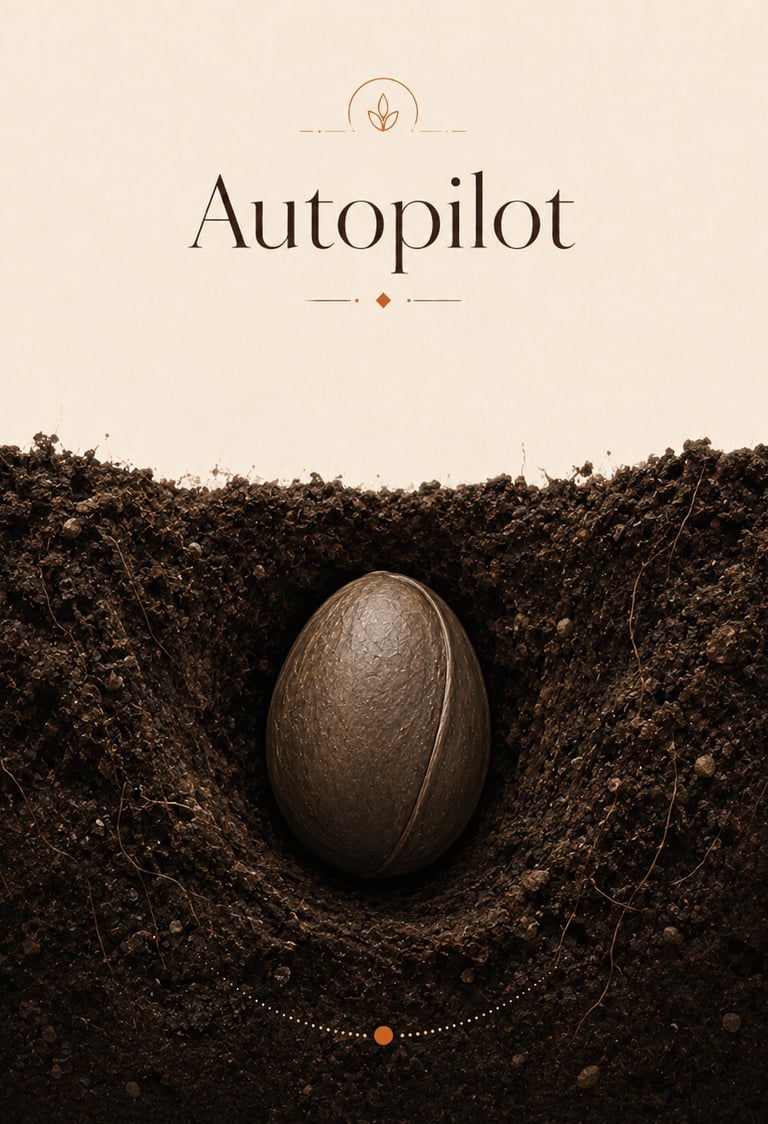
Autopilot is the stage where learned patterns and survival strategies carry life.
Like a seed enclosed by a tough outer coat, something alive is being protected beneath the surface. The coat keeps the seed intact while it remains dormant. It holds life in, shields it from what it is not yet ready to meet, and preserves what may one day emerge.
Human beings have protective coverings too.
They may not look like a shell. They may look like functioning, showing up, working, caring, managing, performing, producing, or holding everything together. They may look like staying busy, staying strong, staying useful, staying quiet, staying in control, or staying out of reach.
Much of life may still be unfolding through patterns your system learned in order to keep going.
These patterns may have protected you from feeling too much at once.
They may have helped you meet demands when there was no room to pause.
They may have allowed you to survive what you did not yet have the capacity, support, or safety to process.
For a long time, they may have helped you stay intact.
But over time, what once protected life can begin to limit it. What once helped you continue can begin to cost too much.
The old patterns may still run, but they no longer restore you. Relief becomes shorter. Effort becomes heavier. Your life begins to narrow around managing, recovering, reacting, or holding yourself together.
The question of this stage is:
What has been running beneath my awareness?
Break
When what hurts can no longer be pushed through
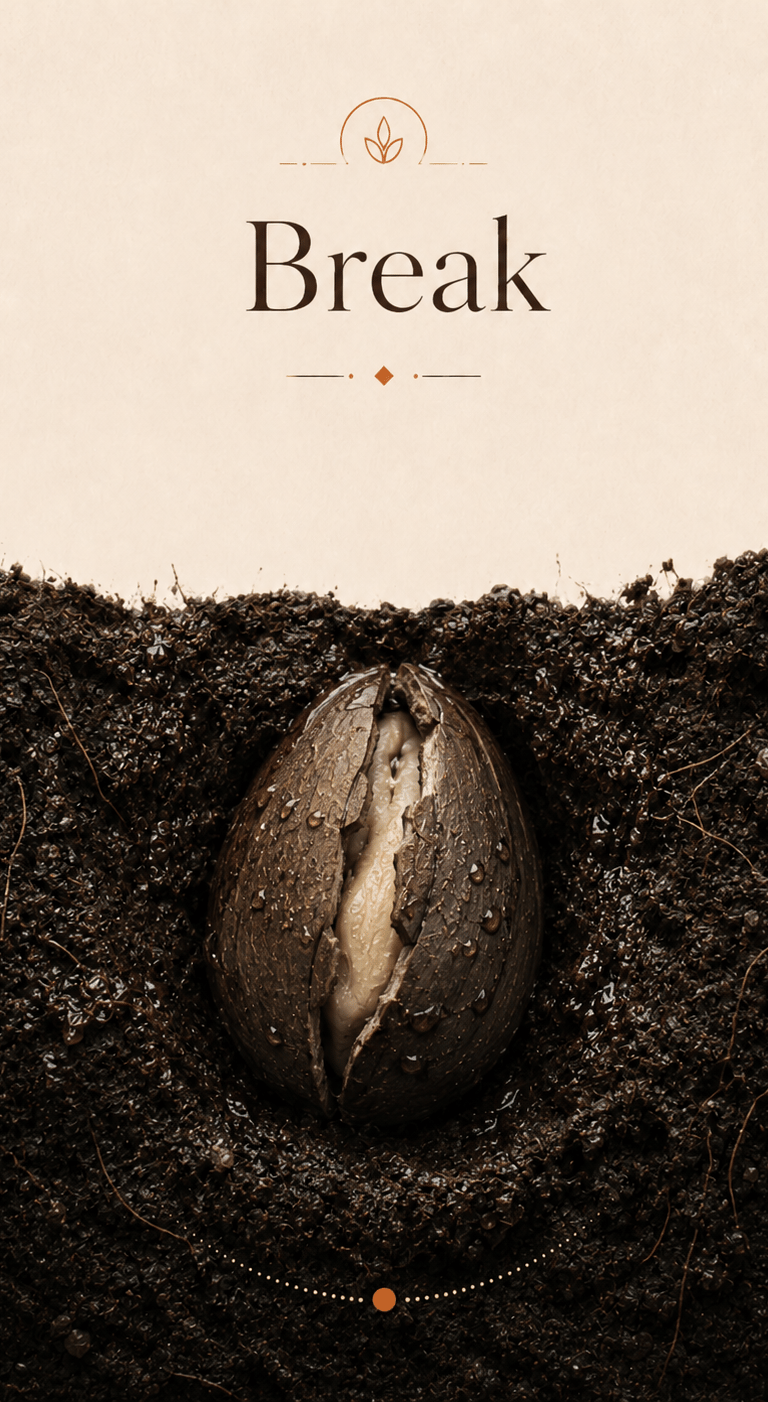
Break is the stage where pain or distress becomes too present to keep moving past.
Like a seed taking in water, something has entered deeply enough that the old enclosure begins to change. What was sealed starts to swell. What was held tightly begins to press against the outer shell. The seed coat softens, strains, and finally cracks.
Life has been happening.
Much has been absorbed.
What was once protective can no longer remain intact.
This is not a gentle stage.
Something hurts, and this time it does not pass through the way it used to. It stays. It gathers weight. It begins to interrupt how you sleep, think, relate, work, decide, or move through the day.
The pain and distress are felt.
They hurt.
They can be intense.
The old ways that would have helped you get through before are no longer working. They may still offer some relief for a moment, but the relief does not last. The weight returns, sometimes heavier than before.
The break is painful. And even though it may not feel like it, the break is not destruction.
It is an opening.
What has been sealed away is becoming impossible to keep sealed. What has been carried quietly is now asking for care. What has been pushed through is asking to be met.
The question of this stage is:
How do I meet what hurts so it does not grow heavier?
Pleasantview Gem Inn
Not just pleasant on the outside, our Pleasantview Gem Inn properties are especially popular among families. With underground parking and floor-to-ceiling windows, there's no shortage of natural light or space.


Reach Out:
© 2026. Milu Tilleli Limited
All rights reserved.
We are not here to survive and grind.
We are here to Flourish by Design.
Guided by intention, integrity, and meaningful impact.


Connect:




Important Note
This work is educational and non-clinical. It draws on lived experience, research, and reflective practice, and is grounded in recovery-oriented, trauma-informed, and whole-person approaches.
Its purpose is to support well-being, personal growth, human flourishing, and the collective good through learning, reflection, and practical tools. It honors personal agency and the many biological, psychological, social, spiritual, and environmental conditions that shape human life.
This work does not diagnose, treat, cure, or prevent any medical or mental health condition. It is not a substitute for medical treatment, mental health care, crisis support, or other professional care when needed.
You are invited to engage at your own pace, in ways that respect your capacity, context, needs, and goals.
If you are experiencing significant distress, ongoing mental health challenges, or feel you may benefit from clinical care, seeking support from a qualified healthcare or mental health professional is encouraged.
contact@livingfullytogether.com